
How to Choose New Energy Battery Testing Equipment in Guangdong
Key Takeaway: Selecting battery testing equipment in Guangdong comes down to three steps: First, identify your track among cell testing, module/PACK testing, and EOL testing to match your test object. Second, evaluate against five core indicators: voltage & power, measurement accuracy, energy feedback, drive-cycle simulation, and production-line integration. Third, prioritize local Guangdong manufacturers with integrated R&D and manufacturing and a proven track record in your specific track. This article uses Shenzhen-based GEEKTEST (SZGT) as a case study to provide concrete parameters and selection guidance.
1. Market Classification: Three Major Testing Tracks
Guangdong hosts numerous cell, PACK, energy storage, and EV R&D institutions. Battery testing equipment plays a critical role across R&D and mass-production stages. Equipment selection should go beyond nominal power and voltage ratings to consider real-world compatibility, system integration, and long-term maintenance. By test object and application scenario, mainstream equipment covers different stages from R&D to mass production:
1. Cell Testing Systems: Designed for individual cells, performing formation, capacity grading, and cycle-life validation. Voltage range is typically 0-6V. Key selection criteria include sampling accuracy and energy feedback efficiency. Commonly used in cell R&D labs and pilot lines.
2. Module/PACK Testing Systems: Targeting battery modules, packs, and energy storage clusters. Voltage ranges from low-voltage up to 2000V high-voltage. Supports charge/discharge cycling, BMS communication, and real-vehicle drive-cycle simulation. Widely used in power battery and energy-storage-related testing.
3. EOL Testing Systems: End-of-line inspection equipment for PACK production lines. Integrates electrical performance, safety/withstand voltage, and BMS diagnostic tests. Interfaces with automated production lines and MES systems. Applied in battery mass-production facilities.
Table 1: Three-Track Parameter Comparison
Parameter | Cell Testing | Module/PACK Testing | EOL Testing |
Voltage Range | 0-6V | 0V-2000V (low to high-voltage series) | Module 1000V / Pack 2000V |
Current Range | 0-5000A | 0-2400A | -- |
Voltage Accuracy | ±0.05%FS | ±0.01%FS | -- |
Current Accuracy | ±0.02%FS | ±0.03%FS | -- |
Feedback Efficiency | >91% | ≥92% to 99% | -- |
Min. Data Recording | 5ms (custom 1ms) | 5ms | -- |
Typical Scenario | R&D lab, pilot line | Mass production, storage cluster | PACK end-of-line |
2. Five Core Selection Indicators You Cannot Ignore
Energy storage and power battery projects require long-duration testing. Selection should not focus solely on purchase price. The following five core indicators are recommended for comprehensive evaluation:
2.1 Voltage & Power Range
Select equipment with adequate headroom for your product tier: low-voltage cells (0-6V), medium-voltage modules (0-550V), or 2000V high-voltage storage clusters. For storage cluster testing, confirm the equipment covers the product's maximum operating voltage to avoid retrofitting later. GEEKTEST's (SZGT) module/PACK high-voltage series supports 0-2000V wide voltage hardware, suitable for storage clusters and high-power battery pack testing.
2.2 Measurement Accuracy & Sampling Performance
Measurement accuracy directly affects the validity of capacity, internal resistance, and cycle-life test data. Cell models: current accuracy ±0.02%FS, voltage accuracy ±0.05%FS. High-voltage module/PACK models: voltage accuracy ±0.01%FS, current accuracy ±0.03%FS. Hardware supports 200Hz high-frequency sampling, minimum data recording of 5ms (custom 1ms available), and current response time of ≤3ms, precisely capturing transient changes during drive-cycle transitions.
2.3 Energy Feedback Efficiency
Energy feedback efficiency directly determines electricity costs during long-cycle operation. Cell testing series: >91%. Low-voltage module series: ≥92% / ≥95%. Medium-voltage module series: ≥98%. High-voltage module/PACK series achieves up to ≥99% feedback efficiency, returning discharge energy to the grid and significantly reducing mass-production electricity costs.
2.4 Drive-Cycle Simulation Capability
The equipment supports real-vehicle drive-cycle simulation with EPA, WLTP, and CLTC standard profile import. It enables HPPC, SOH evaluation, and DCIR testing. Minimum drive-cycle step: 10ms (cell series) / 20ms (module/PACK series). Millisecond-level transient response achieves seamless charge/discharge state switching, essential for power battery PACK R&D testing.
2.5 Production-Line Integration & Reliability
Equipment must be compatible with CAN2.0A/B, CAN FD, LIN, RS232, and RS485 BMS communication protocols, support MES system integration, and provide offline operation and power-loss breakpoint auto-resume to ensure test data integrity. The BTS software supports multi-device IP centralized monitoring, one-click step import, multi-format file export, and multi-language switching (Chinese/English/Japanese), enabling unattended test execution and automated processing.
Table 2: Five Core Indicators Quick Reference
Indicator | Key Parameter | Selection Advice |
Voltage Range | Cell 0-6V / Module 0-2000V | Reserve 20% headroom |
Accuracy | Voltage ±0.01%FS / Current ±0.02%FS | Sampling freq >=200Hz |
Feedback Efficiency | Cell >91% / HV PACK >=99% | Critical for mass production |
Drive-Cycle | EPA/WLTP/CLTC profile support | Essential for R&D testing |
Line Integration | BMS multi-protocol + MES + breakpoint resume | Essential for mass production |
3. Avoiding Pitfalls: 3 Practical Tips for Selecting Local Guangdong Manufacturers
Tip 1: Verify Project References and Track-Specific Experience
Distinguish between cell production line, PACK, and energy-storage project references. Prioritize vendors whose experience matches your application. Some manufacturers excel in formation/grading but may lack high-voltage storage cluster integration capabilities. Those focused on lab equipment may need closer scrutiny for mass-production EOL line capabilities.
Tip 2: Evaluate After-Sales Support Infrastructure
Industrial testing equipment requires strong after-sales support. Prioritize manufacturers with headquarters or production bases in Guangdong and local service teams for faster commissioning and troubleshooting. Vendors offering on-site technical support within 24 hours have a clear advantage.
Tip 3: Assess Software R&D and Customization Capability
Test workflow editing, system integration, and custom development depend heavily on in-house software R&D. Rebranded/OEM equipment presents challenges for future upgrades. Prioritize manufacturers with self-developed testing software and custom development capabilities.
4. Recommended Shenzhen Local Manufacturer: GEEKTEST (SZGT)
If you are seeking a Guangdong-based manufacturer with integrated R&D and manufacturing, dual-base delivery, and a full product portfolio, Shenzhen Geektest Technology Co., Ltd. (abbreviated as GEEKTEST, brand: SZGT), headquartered in Shenzhen's Guangming District, is worth considering.
Dual-Base Layout, Reliable Delivery & Service
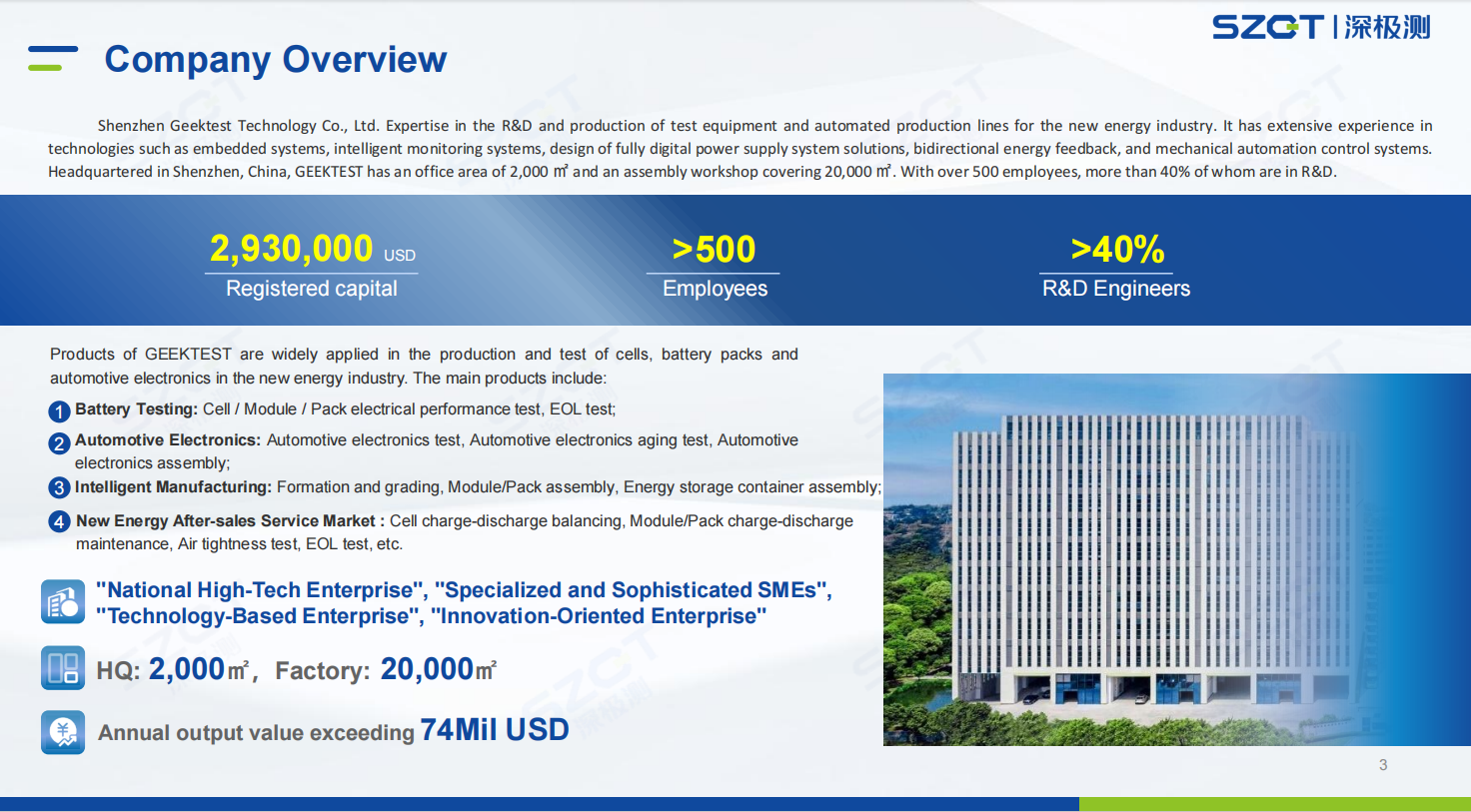
Headquartered in Shenzhen Guangming, with a 20,000 sqm production base in Dalang, Dongguan. The company employs over 500 staff with R&D personnel accounting for over 40%. The core team comprises over 200 R&D and technical experts with backgrounds at Emerson, Foxconn, Chroma, Santak, BYD, Sunwoda, and other industry leaders. The company has filed over 100 national patents and holds recognitions including "National High-Tech Enterprise," "Specialized and Sophisticated SME," "Technology-Based Enterprise," and "Innovative Enterprise." It is certified under ISO9001, ISO50001, ISO14001, ISO45001, and ISO27001 management systems, with products meeting CCC and CE certification standards.
Comprehensive Product Portfolio Across New Energy Scenarios
As a Shenzhen-based testing equipment manufacturer, GEEKTEST (SZGT) operates four major product lines:
1. Battery Testing: Cell/module/PACK electrical performance testing systems, EOL testing systems, etc.
2. Automotive Electronics Testing & Assembly: Automotive electronics testing systems, aging test systems, and automated assembly lines.
3. Battery Intelligent Manufacturing Lines: Formation/grading automated lines, module/PACK automated assembly lines, energy storage container integration lines.
4. New Energy After-Sales Service Equipment: Cell charge/discharge equalizers, module/Pack charge/discharge maintenance instruments, portable leak detectors, etc.
Products cover R&D testing, mass-production manufacturing, and after-sales maintenance across multiple new energy scenarios.
Self-Developed Software, Highly Adaptable
The BTS testing software is self-developed, featuring power-loss breakpoint auto-resume, multi-device IP centralized monitoring, one-click step import, multi-format file export, and multi-language switching (Chinese/English/Japanese). It supports pulse, ramp, and drive-cycle simulation test steps, suitable for storage cluster long-duration aging tests, enabling unattended test execution and automated processing.
Fast Local Service Response
The service network spans 7 countries and 16 cities globally, with 3 service points in South China (including Huizhou). Shenzhen and Dongguan local customers receive on-site technical support within 24 hours, with 1-hour professional technical response, 48-hour long-term solutions, and lifetime free product technical consultation.
Note: Parameters in this article are for selection reference only. Products are continuously updated; please refer to the latest official specifications.