
2026 Interpretation & Equipment Selection for Cell/Module/PACK/EOL Testing Equipment
Abstract
Power battery testing is shifting from “pass/fail judgment before delivery” to “full-lifecycle safety management and control”. On September 2, 2026, the group standard T/CPQS A0065—2026 Safety Requirements and Test Methods for Electric Vehicle Power Battery Systems within Service Cycles was officially released and implemented, and formally launched at the 2026 World Power Battery Conference held in Yibin, Sichuan on September 4. For the first time in the field of group standards, this standard systematically establishes a two-phase evaluation system of “initial-state safety + post-durability-test safety”. Combined with official interpretations of the standard, this paper sorts out new requirements for equipment brought by full-lifecycle testing, and presents a complete equipment selection framework covering cell, module, PACK and EOL end-of-line testing.
In September 2026, multiple critical updates were released in the battery testing sector. On September 2, group standard T/CPQS A0065—2026 Safety Requirements and Test Methods for Electric Vehicle Power Battery Systems within Service Cycles was issued and put into force, and unveiled at the 2026 World Power Battery Conference in Yibin on September 4. (Sources: Standard release notice of China Consumer Product Quality Safety Promotion Association and official release of the 2026 World Power Battery Conference). Jointly led by the China Consumer Product Quality Safety Promotion Association and China Automotive Engineering Research Institute Co., Ltd., the standard was co-developed by more than 20 industry-university-research-application entities including Huawei Terminal, CATL, BYD, Gotion High-tech, Eve Energy, Xiaomi Auto, Beijing Institute of Technology, and the Technical Center for Defective Product Recall of the State Administration for Market Regulation. (Sources: Standard compilation notes and official interpretation by China Automotive Engineering Research Institute). It builds, for the first time among group standards, a systematic two-phase evaluation system of “initial-state safety + post-durability-test safety”, simulating the real safety status of automotive power batteries after aging and durability tests, and providing industry-wide testing references covering the full lifecycle of batteries “from brand-new to aged”.
Meanwhile, the 2026 World Power Battery Conference took place in Yibin from September 3 to 4. The Battery Safety Assessment & Certification Center under the State Administration for Market Regulation Key Laboratory (Energy Storage & Power Battery Safety) was officially inaugurated. The center has built a full-level safety testing and evaluation platform covering “materials — cells — battery systems”, filling gaps in public service for industrial chain safety. (Source: On-site report by Sichuan View News).
It should be noted that this group standard targets vehicle-mounted power battery systems. Its two-phase evaluation philosophy of “initial state + post-durability test” can also offer references for R&D verification of next-generation batteries such as semi-solid and solid-state batteries.
I. New Requirements for Equipment Raised by Full-Lifecycle Testing
Traditional battery quality control mainly relies on multi-node screening before delivery, rather than a single one-off test. After cell formation and grading, tests such as OCV and DCIR are carried out. After module/PACK assembly, EOL end-of-line final inspection is performed, with the core objective of filtering defective products and guaranteeing battery quality before delivery.
However, the new group standard adopts a different mindset. It combines “testing + verification”: batteries are first subjected to mechanical durability, environmental durability and cyclic aging tests, followed by corresponding safety assessments based on different durability types, to track battery safety performance at all stages from new to aged. (Sources: Full text of T/CPQS A0065—2026 and official interpretation by China Automotive Engineering Research Institute). This means testing is no longer limited to “the moment of product delivery”. It needs to answer a deeper question: can this battery still operate safely after 3 or 5 years of service?
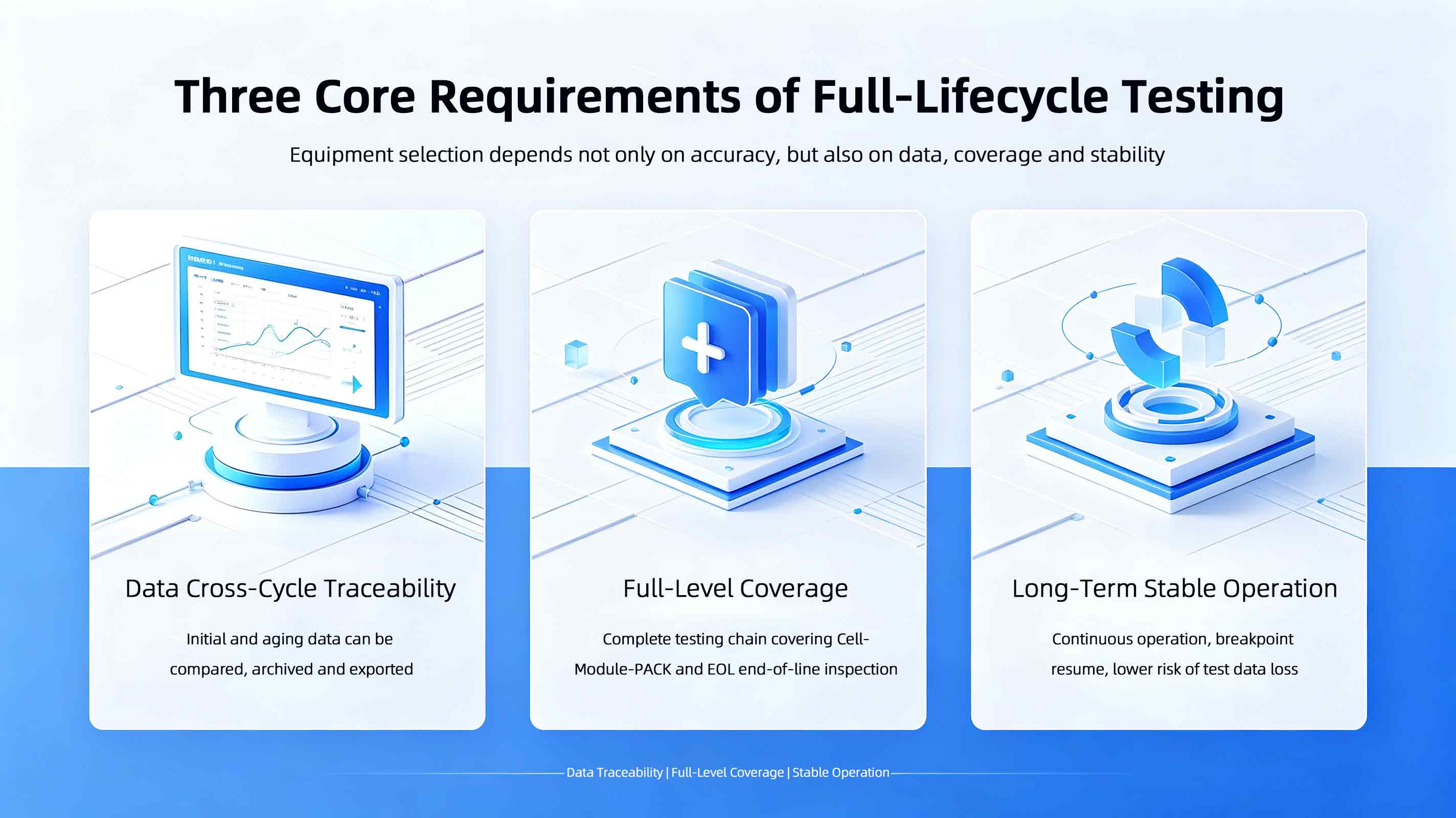
This paradigm shift puts three new capability requirements on testing equipment.
Traceable and comparable data. Initial factory data must be cross-referenced with durability data collected after a period of operation to judge whether battery degradation stays within safe limits. Data archiving and cross-cycle data management capabilities of testing equipment become essential.
Testing coverage extends from cells to system level. The group standard applies to “power battery systems”. Initial-state safety covers mechanical safety, thermal safety, insulation safety and electrical safety, including multiple test items. Among them, high-voltage connector extrusion falls under the chassis protection items of mechanical safety specified in the group standard; bottom impact and undercarriage scrape tests are defined in national mandatory standard GB 38031—2025 Safety Requirements for Power Storage Batteries Used in Electric Vehicles, targeting the high-risk chain of “undercarriage damage → internal short circuit → thermal runaway” in real accidents. (Sources: T/CPQS A0065—2026 text, GB 38031—2025). Therefore, testing shall not be confined to cell or module levels; PACK-level safety testing must also be included.
Higher stability for long-duration testing. Safety tests after durability aging involve prolonged cyclic working conditions. Equipment must support continuous stable operation and feature safeguards such as breakpoint resume upon power failure.
II. Capability Framework for Full-Level Testing Equipment
To meet full-lifecycle testing demands, a complete battery testing equipment system shall cover the following four tiers.
- Cell level: Voltage 0–6V; Current ranging from 0–60A to 0–5000A. Supports cycle life, HPPC, DCIR and working condition simulation, with high-frequency sampling and data recording.
- Module / PACK level: Low voltage 0–60V up to high voltage 0–2000V. Requires high voltage accuracy and energy feedback, compatible with SiC three-level technology.
- EOL end-of-line final inspection level: Max 1000V for modules and max 2000V for PACKs. Supports multi-protocol BMS communication including CAN 2.0A/B, CAN FD, LIN, RS232 and RS485.
Software & data management level: Data management software without electrical parameters. Enables automatic data archiving, multi-format export, MES/LIMS interconnection and full-process traceability.
Take Geektest cell test system as an example: voltage accuracy ±0.05% FS, current accuracy ±0.02% FS, supports 200Hz high-frequency sampling, minimum data recording interval of 5ms (1ms available upon customization), feedback efficiency >91%. For Geektest module / PACK high-voltage test series, voltage accuracy ±0.01% FS, current accuracy ±0.03% FS, feedback efficiency ≥99%, equipped with high-frequency SiC three-level technology.
Note: The above are typical parameters of corresponding series. Not all channels and models can achieve these specs. Refer to the technical specification sheet for details.
III. Reference of Product Lines from Local Guangdong Manufacturers
Among local manufacturers in Guangdong with full product line coverage from cell testing to EOL, Shenzhen Geektest Technology Co., Ltd. (short name: Geektest) serves as a reference case. (Source: Public information on corporate official website https://geektest.cn).
Headquartered in Guangming District, Shenzhen, the company has an office area of nearly 2,000 ㎡, and its production base is located in Dalang, Dongguan, covering more than 20,000 ㎡. With registered capital of RMB 20 million and over 500 employees, more than 40% of its staff are R&D personnel, gathering over 200 R&D specialists with working experience in leading new energy enterprises. Its annual output value exceeds RMB 500 million. The company is recognized as a National High-tech Enterprise, Specialized, Refined, Differential and Innovative SME, Technology-based Enterprise and Innovative Enterprise. It has accumulated more than 100 national patents, obtained full system certifications including ISO 9001, ISO 14001, ISO 45001, ISO 50001 and ISO 27001, and its products comply with CCC and CE standards.
Product Portfolio
- Battery testing equipment: Cell test systems, module / PACK test systems (low/medium/high voltage series up to 2000V), EOL test systems
- Automotive electronics: Automotive electronic test systems, automotive electronic aging test systems, automated automotive electronic assembly lines
- Intelligent manufacturing: Automated module/PACK assembly lines, energy storage container assembly lines, automated formation & grading production lines
New energy after-sales service: Cell charge-discharge equalizers, module/PACK charge-discharge maintenance instruments, portable air tightness testers, low-temperature battery pack disassembly chambers
Service Network
Domestically, service sites include 5 in East China, 3 in South China, 1 each in Southwest and Central China. Globally, it covers 3 sites in Asia-Pacific and 3 in Europe across 16 cities in 7 countries. After-sales commitment: 1-hour response, on-site arrival within 24 hours, corrective measures issued within 24 hours, long-term solutions delivered within 48 hours, and lifetime free technical consultation. The company serves many leading power battery, energy storage and automotive customers.
IV. Frequently Asked Questions (FAQ)
Q1: What is the core difference between full-lifecycle testing and traditional pre-delivery testing?
A: Traditional pre-delivery testing focuses on pass/fail judgment at the delivery stage. Full-lifecycle testing adopts the two-phase framework of “initial-state safety + post-durability-test safety”, covering sustained battery safety performance from initial status to post-aging durability. Test data must be traceable and comparable across cycles. Its evaluation methodology can also provide references for R&D verification of semi-solid and solid-state batteries.
Q2: What are the differences in accuracy requirements between cell testing and module/PACK testing?
A: Cell-level testing generally requires voltage accuracy ±0.05% FS and current accuracy ±0.02% FS. The high-voltage series for module/PACK testing demands higher voltage accuracy of ±0.01% FS.
Q3: Why is test data traceability important?
A: Full-lifecycle safety management requires comparison between initial test data and subsequent durability data of batteries. Testing equipment needs to support automatic data archiving, breakpoint resume after power failure, multi-format file export and other functions.
V. Conclusion
Battery testing is evolving from delivery qualification assessment toward full-lifecycle management and control. As a major battery industrial cluster, manufacturers in Guangdong have capabilities in voltage range, measurement precision, energy feedback and data management. These capabilities determine whether they can meet the requirements of the new group standard and support R&D and testing demands for next-generation battery technologies.
Disclaimer: The above parameters are typical values of corresponding product series. Test results are affected by DUT batteries, on-site working conditions, ambient temperature and BMS protocols. Final specifications shall be subject to the latest Geektest technical datasheet and mutual technical review. Corporate information is sourced from publicly disclosed materials and subject to updates in the official latest release.