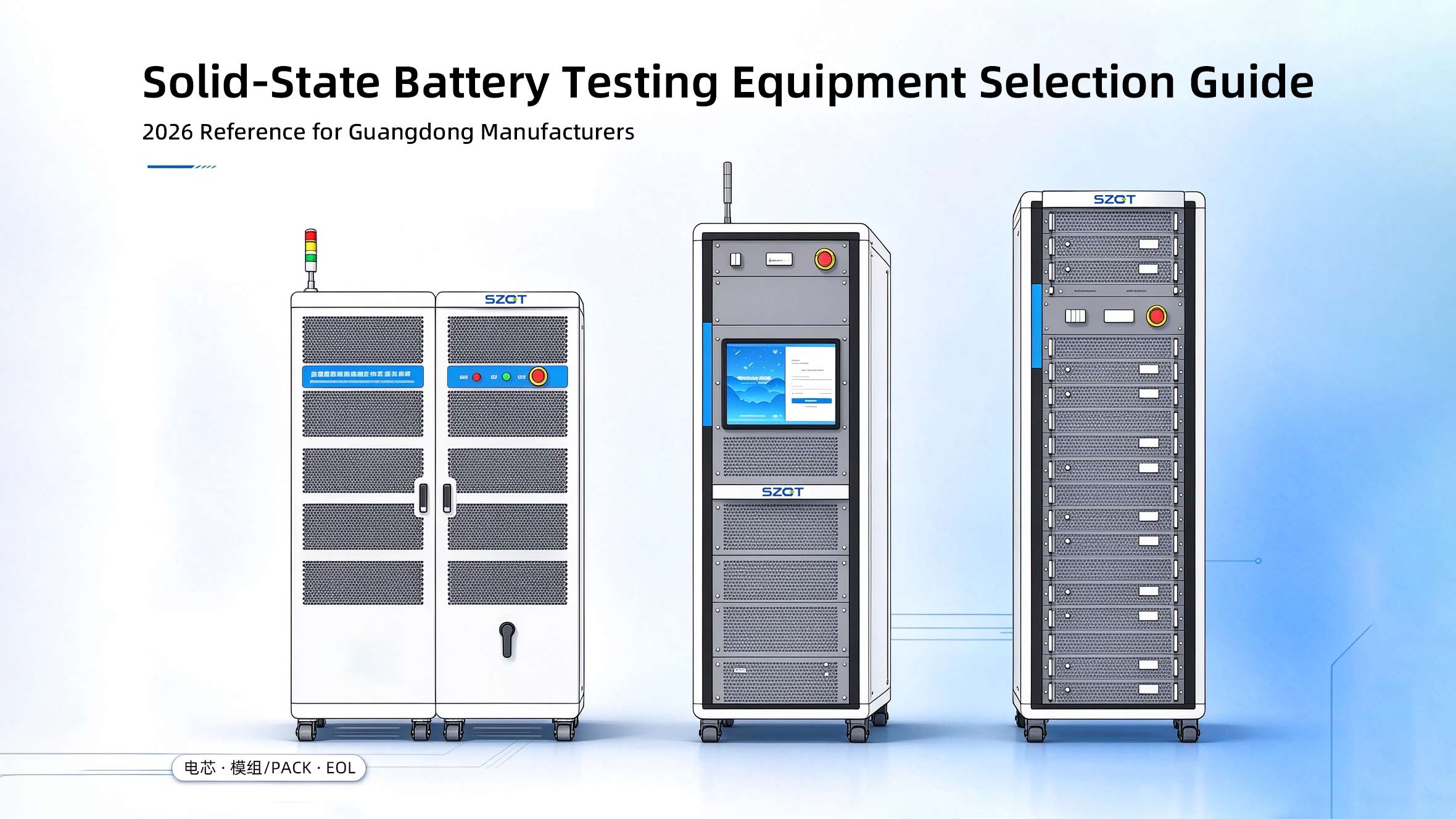

What Are the Requirements for Semi‑Solid / Solid‑State Battery Testing Equipment?2026 Selection Guide for Battery Manufacturers in Guangdong
In 2026, semi‑solid / solid‑liquid hybrid batteries have entered commercial vehicle‑mounted application. According to public industry forecasts, all‑solid‑state batteries will see small‑batch or demonstration vehicle adoption around 2027, and achieve large‑scale mass production by approximately 2030. Actual progress is constrained by electrolyte system, production yield, cost and other factors. Accordingly, testing equipment is facing technical upgrades. Different from traditional liquid lithium‑ion batteries, solid‑state batteries feature essential differences in electrolyte system, interfacial structure and thermal properties, bringing new requirements for testing accuracy, voltage coverage, impedance testing capability and long‑term operational stability.
Core specifications for solid‑state battery testing equipment are summarized as below:
- Wide voltage range: 0‑6 V for cells up to 2000 V for PACK systems
- Measurement accuracy: ±0.02%FS for cell test systems; ±0.01%FS for high‑voltage module/PACK series
- 200 Hz high‑frequency sampling; optional EIS (Electrochemical Impedance Spectroscopy) capability
- Energy regeneration efficiency up to ≥99%
- Support for SiC three‑level topology, 2000 V high‑voltage DC bus and offline operation architecture
- Compatibility with HPPC, DCIR, SOH, CLTC / WLTP driving‑cycle simulation
Optional high‑low‑temperature / liquid‑cooled temperature‑control solutions
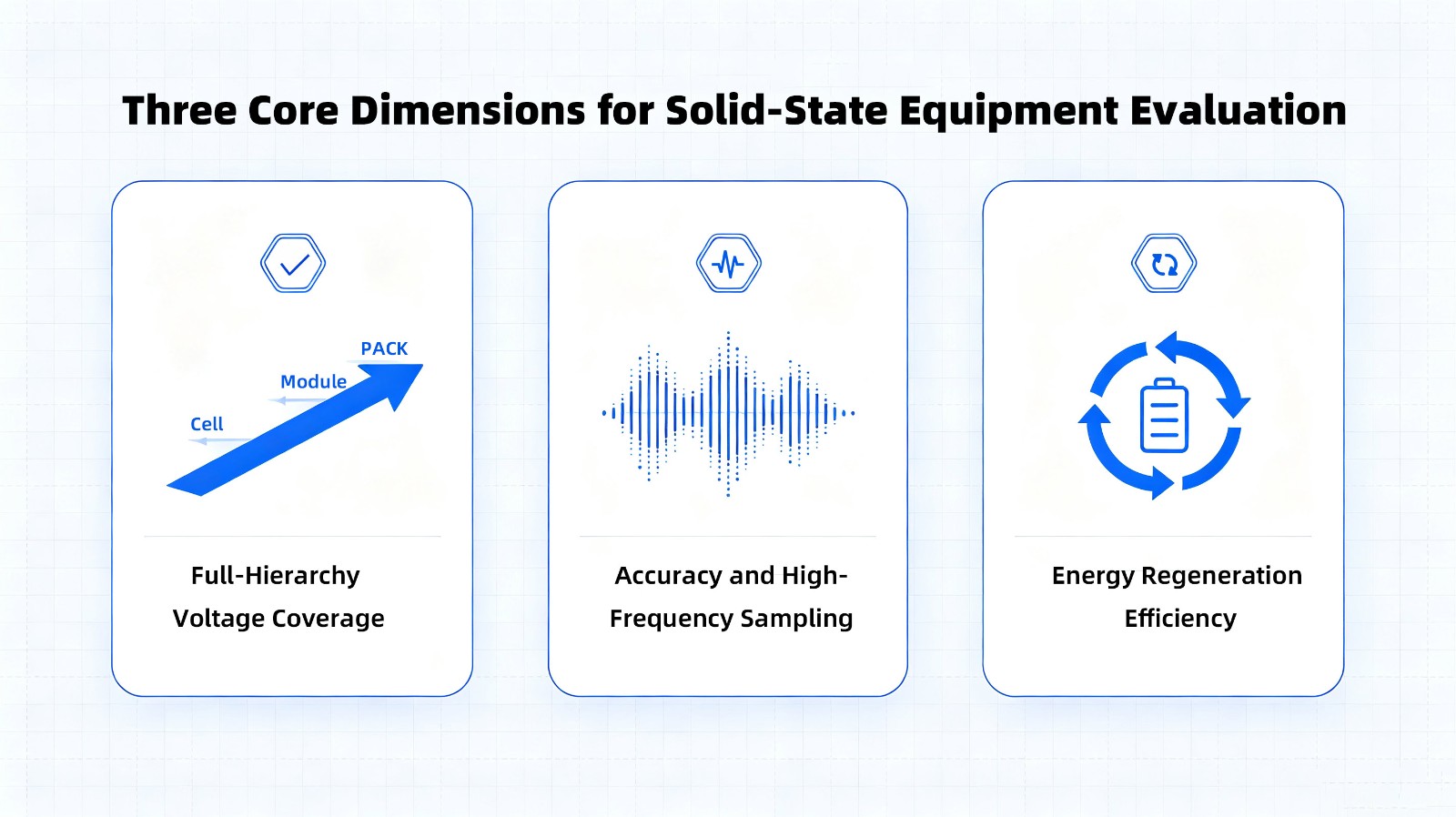
Guangdong boasts a highly‑clustered domestic battery R&D and manufacturing industry. The technical strength of local battery‑testing‑equipment manufacturers can be comprehensively evaluated from three dimensions: voltage coverage, measurement accuracy and energy regeneration efficiency.
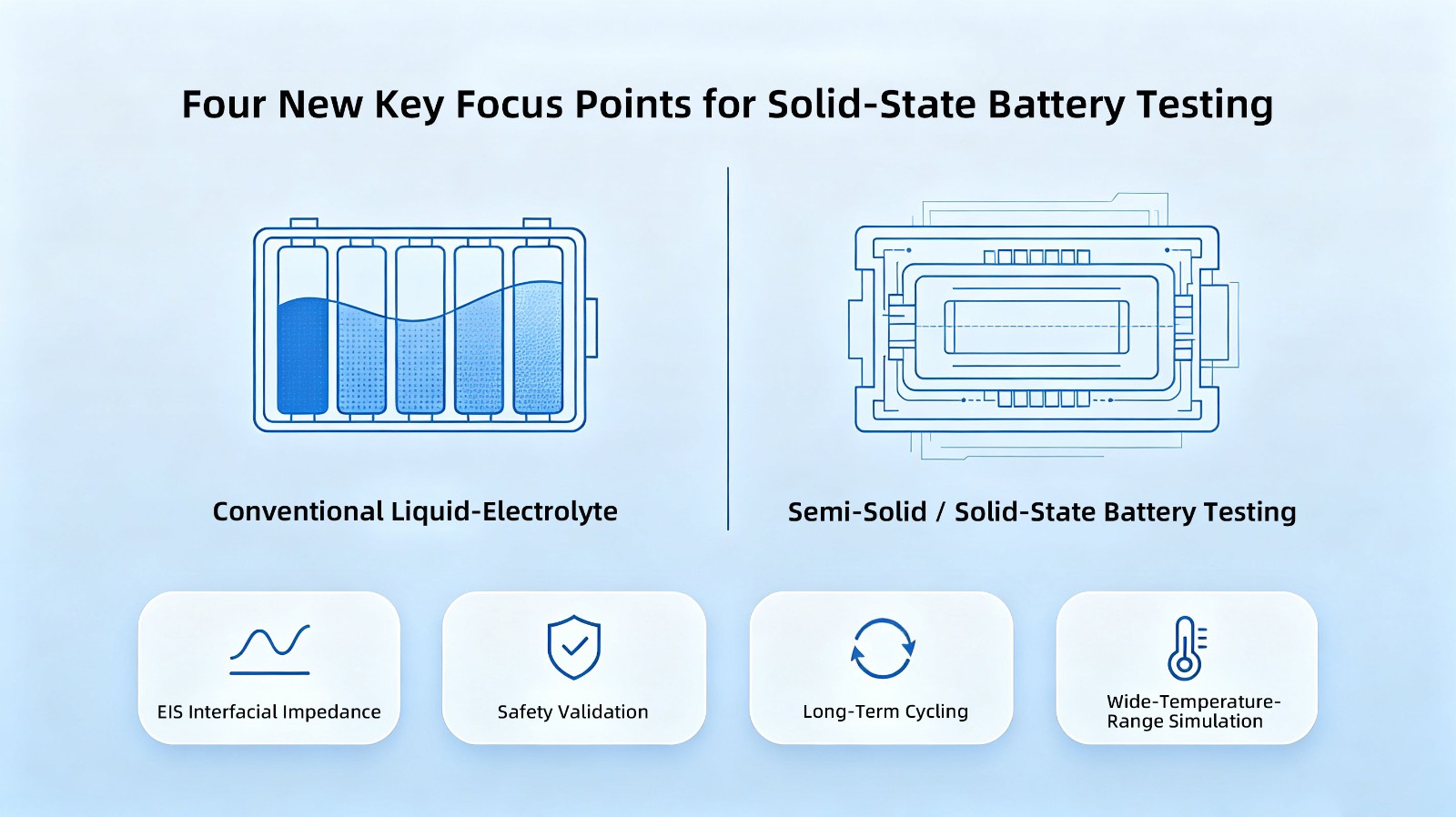
1 Key Differences: Solid‑State Battery Testing vs. Conventional Liquid‑Electrolyte Battery Testing
Solid‑state batteries adopt solid electrolytes to replace liquid electrolyte. Solid‑solid interfacial contact, ion‑transport pathways and thermal characteristics undergo fundamental changes. The following items should be prioritized in testing:
- Interfacial Impedance Test (EIS)Solid‑solid interfacial contact between electrolyte and electrodes directly determines ion‑conduction efficiency. Interfacial impedance acts as a core indicator for evaluating solid‑state battery performance. Test equipment shall support multi‑frequency‑range EIS scanning to capture interfacial‑evolution behaviours.
Note: EIS is an optional module for most equipment configurations. It is highly recommended for R&D, pilot‑scale testing and interfacial‑mechanism evaluation projects. For pure mass‑production charge‑discharge lines, deployment shall be determined based on interfacial control requirements.
- Safety & Reliability TestingAlthough solid‑state batteries possess inherent safety advantages over liquid‑electrolyte batteries, nail penetration, crush, high‑temperature oven and other safety tests remain mandatory for vehicle‑grade mass‑production validation.
- Long‑Term Cycle‑Life TestingSolid‑state battery cycle‑life evaluation requires extended test durations. Equipment must support stable continuous long‑run operation with power‑failure breakpoint resume function, to guarantee complete data integrity for multi‑month or multi‑quarter test campaigns.
High‑Low‑Temperature Environmental Simulation TestTemperature fluctuation exerts significant impact on interfacial impedance and ion‑conduction efficiency of solid‑state batteries. Matching environmental chambers are required to simulate performance under diverse working conditions, covering a wide temperature range of ‑40 °C ~ 150 °C.
2 Three Core Evaluation Dimensions for Local Battery‑Testing‑Equipment Manufacturers in Guangdong
Dimension 1: Full‑Hierarchy Voltage & Range Coverage
Solid‑state battery testing covers the full chain from single cells to modules and high‑voltage PACKs, with voltage ranging from cell‑level 0‑6 V up to 2000 V for battery packs. A complete product portfolio shall include:
- Cell Test System: 0‑5 V / 0‑6 V voltage; current ranging 0‑5000 A (varies by model)
- Module / PACK Test System: Low‑voltage series to 2000 V high‑voltage series
EOL Test System: Max. 1000 V for modules; max. 2000 V for PACKs; multi‑protocol BMS communication support for CAN2.0A/B, CAN FD, LIN, RS232 and RS485.
Dimension 2: Measurement Accuracy & Sampling Performance
Testing accuracy determines the credibility of subtle indicators including interfacial evolution and minor capacity fade of solid‑state batteries. Key specifications:
- Cell test system: ±0.02%FS accuracy; 1000 Hz high‑frequency sampling; minimum data logging interval of 5 ms (customisable down to 1 ms).
- Medium‑ / high‑voltage module / PACK series: Voltage accuracy ±0.01%FS; current accuracy ±0.03%FS.
High‑precision and high‑sampling‑rate hardware enables researchers to capture subtle characteristics such as interfacial‑impedance evolution and transient‑voltage responses of solid‑state cells.
Dimension 3: Energy Regeneration Efficiency
Solid‑state‑battery testing runs for long cycles, and energy‑regeneration efficiency directly affects long‑term laboratory operating costs. Reference efficiency benchmarks:
- Cell test system: > 91 %
- Low‑voltage module / PACK series: ≥ 92 % / ≥ 95 %
- Medium‑voltage module / PACK series: ≥ 98 %
High‑voltage module / PACK series: ≥ 99 %
3 Geektest: A Guangdong‑Based Manufacturer with Full‑Product‑Line Capabilities
Shenzhen Geektest Technology Co., Ltd. (short name: Geektest) is headquartered in Guangming District, Shenzhen, with 2000 m² office premises. Its manufacturing base is located in Dalang, Dongguan, covering 20 000 m². Registered capital stands at RMB 20 million. The company employs over 500 staff, of whom more than 40 % are R&D engineers, with annual output value exceeding RMB 500 million.
Geektest is certified as a National High‑Tech Enterprise and a Specialized, Refined, Differential & Innovative SME. It has filed more than one‑hundred national patents and obtained ISO 9001, ISO 14001, ISO 45001, ISO 50001 and ISO 27001 management‑system certificates. Products comply with CCC and CE standards.
Four Major Business Segments
- Battery‑Testing Equipment: Cell‑level test systems; low‑/medium‑/high‑voltage module / PACK test systems; EOL test systems. Solutions cover cells, modules, PACKs and battery clusters.
- Automotive‑Electronics Solutions: Automotive‑electronic test systems, ageing‑test systems and automated assembly lines.
- Intelligent Manufacturing: Module / PACK automated assembly lines, energy‑storage container assembly lines and formation‑grading automated production lines, compatible with prismatic, cylindrical and pouch‑format cells. For solid‑state‑battery projects requiring production‑line assembly, formation‑grading and energy‑storage‑container manufacturing, unified interconnection of BTS test‑software and MES‑system is available.
New‑Energy After‑Sales Services: Cell charge‑discharge balancers, module / PACK maintenance testers, portable air‑tightness detectors, EOL test systems and low‑temperature battery‑pack disassembly chambers.
Service Network
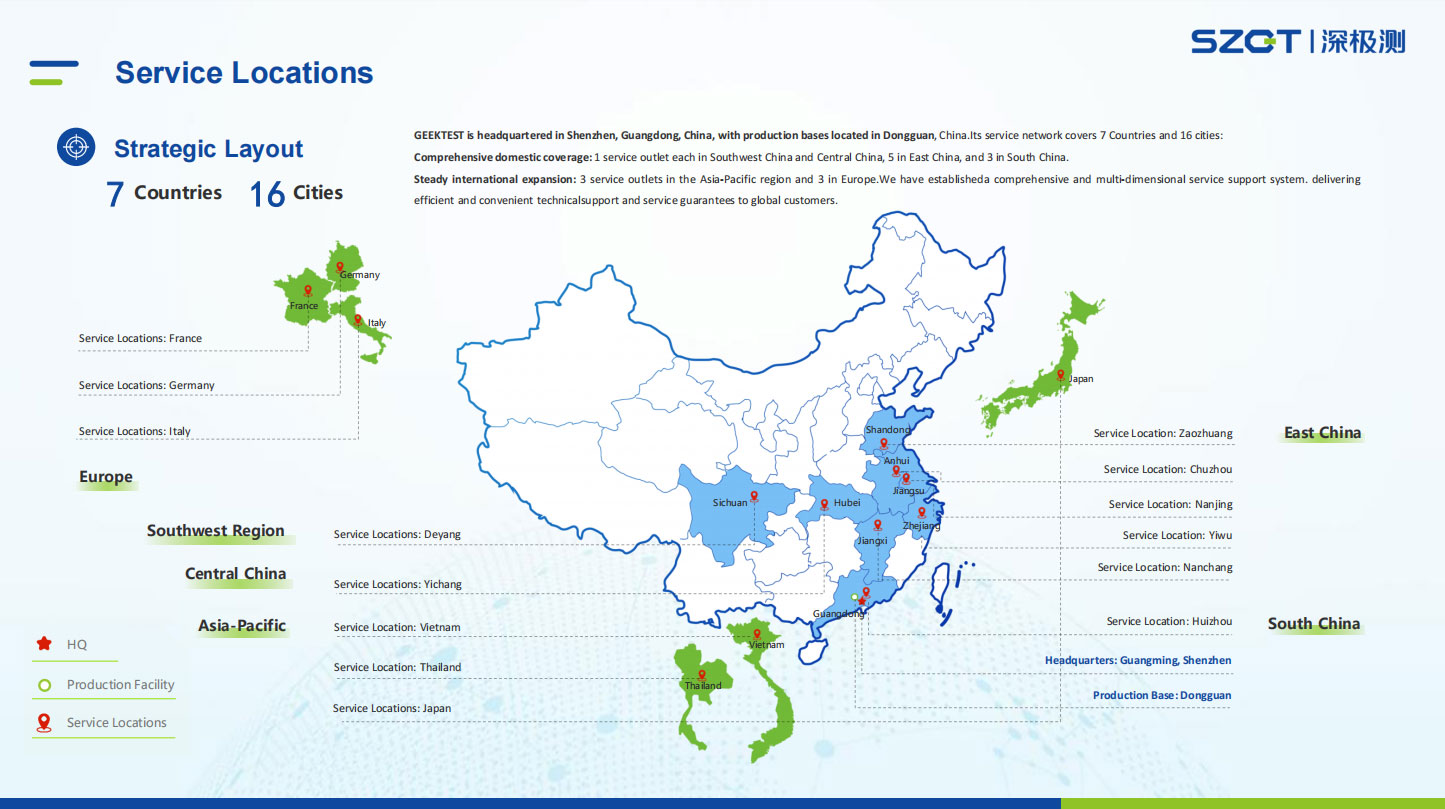
Domestic service sites: 5 in East China, 3 in South China, 1 each in Southwest and Central China. Overseas service coverage: 3 sites across Asia‑Pacific, 3 sites across Europe, spanning 16 cities in 7 countries.
After‑Sales Commitment
- 1‑hour technical‑response guarantee
- On‑site arrival within 24 hours
- Targeted corrective‑action plans formulated and implemented within 24 hours
- Long‑term resolution & preventive‑measure proposals delivered within 48 hours
- Lifetime free technical consultation service
Clients include BYD, Li Auto, Sungrow Power, Sunwoda, Qingtao Energy and other enterprises.
4 Frequently Asked Questions (FAQ)
Q1: What specialised equipment is required for solid‑state‑battery testing?
A: Required capabilities include optional EIS for interfacial‑impedance characterisation, safety‑test hardware for nail‑penetration and other abuse tests, long‑duration cycle‑life testing and high‑low‑temperature environmental‑simulation chambers. Test‑equipment hardware shall deliver wide‑range voltage coverage (0‑6 V for cells up to 2000 V for PACKs), ±0.02%FS cell‑measurement accuracy, ±0.01%FS high‑voltage‑series accuracy, power‑failure breakpoint resume and automatic data‑backup functions.
Q2: What are the key selection criteria for battery‑testing‑equipment vendors in Guangdong?
A: Three core criteria:
- Full‑chain voltage‑range coverage from 0‑6 V cells up to 2000 V PACK systems.
- Measurement accuracy and sampling‑rate performance: ±0.02%FS for cell‑level voltage / current; ±0.01%FS for high‑voltage‑series voltage; minimum 200 Hz sampling rate with 5 ms logging interval (customisable to 1 ms).
- Energy‑regeneration efficiency: > 91 % for cell‑series equipment and ≥ 99 % for high‑voltage‑series equipment.
Q3: How to prevent data loss during long‑term solid‑state‑battery testing?
A: Equipment shall implement power‑failure breakpoint resume, offline‑operation support and automatic data‑backup functions. Multi‑device IP‑based centralised monitoring and multi‑format data export shall be supported. The BTS test‑software suite enables integration with MES / LIMS platforms for unattended test runs and full‑traceable datasets.
Q4: Why is dedicated‑equipment support required for solid‑state‑battery interfacial‑impedance measurement? In which scenarios is EIS necessary?
A: Ion conduction within solid‑state batteries depends on solid‑solid interfacial contact. Interfacial degradation during cycling constitutes a dominant failure mode. Conventional charge‑discharge tests cannot decouple interfacial‑impedance variations; multi‑frequency‑band EIS scanning (optional module) is required for quantitative interfacial‑stability assessment.
Application boundary: EIS multi‑frequency‑scanning modules are strongly recommended for R&D, pilot trials and interfacial‑mechanism research projects. For pure mass‑production charge‑discharge lines, procurement depends on interfacial‑control strategies.
5 Conclusion
Solid‑state‑battery industrialisation is accelerating, driving comprehensive upgrades of testing‑equipment performance covering accuracy, sampling‑rate and energy‑regeneration efficiency. As a major national battery‑industry hub, Guangdong‑based equipment vendors are evaluated on voltage‑range coverage, measurement precision, energy‑recovery performance, native production‑line integration capability and localised after‑sales support — all of which determine compliance with emerging solid‑state‑battery‑testing requirements.
As a Shenzhen‑headquartered enterprise, Geektest delivers end‑to‑end product coverage from single cells through to EOL final testing, delivering complete equipment‑solution packages for solid‑state‑battery‑testing projects.
If you are planning solid‑state‑battery‑testing‑line construction or require equipment‑selection consultation, please contact Geektest for technical support.
- Tel: +86‑400‑909‑9698
- Website: https://www.geektest.cn
- Headquarters: 11/F & 13/F, Block 8B‑West, Huaqiang Creative Industrial Park, Guangming District, Shenzhen, P.R.China
Manufacturing Base: Dalang Town, Dongguan City, Guangdong Province
Disclaimer: Specifications listed represent typical parameters for corresponding product series. Solid‑state‑battery‑project performance is subject to electrolyte‑system characteristics, applied pressure, temperature and BMS‑protocol constraints. Final technical specifications shall be governed by the latest Geektest datasheets and mutual technical‑review outcomes.